Examining the resonance within Billie Eilish's sonic landscape.
THE WHISPER OF THE ID
Billie Eilish and the Architectonics of bad guy
Voxo Magazine examines the sonic architecture of pop’s most magnetic disruptor, Billie Eilish.
Her work operates less as conventional pop expression and more as a psychological environment. A chiaroscuro soundscape built from restraint, proximity, and tension, Eilish’s music resists spectacle and instead weaponizes intimacy. Vulnerability is not framed as weakness but as a calibrated position of power—one that quietly destabilizes the listener.
She does not demand attention
She withholds it
“I’m the bad guy, duh.”
THEMATIC INVERSION
The Psychology of bad guy
bad guy functions as a case study in thematic inversion. Produced with Finneas in a bedroom-scale environment, the track rejects maximalist pop tropes in favor of spatial minimalism. Sub-bass pulses, finger snaps, and near-ASMR vocal delivery are arranged with architectural intent, creating negative space that becomes as expressive as sound itself.
Rather than resisting the “bad guy” label, Eilish adopts it with deliberate irony. This is not roleplay—it is reframing. By claiming the archetype outright, she dismantles its traditional associations with aggression or dominance and replaces them with detachment, control, and self-awareness.
The result is a quiet power shift
Authority no longer arrives through volume or force, but through composure
As part of When We All Fall Asleep, Where Do We Go?, the track aligns with the album’s dream-logic structure. Meaning is fragmented, moods override narrative, and emotional clarity is intentionally deferred. The listener is not guided toward resolution, but toward recognition—of impulses, contradictions, and discomforts that are usually left unarticulated.
A VISUAL DIALECTIC
Surrealism, Distance, and the Gaze
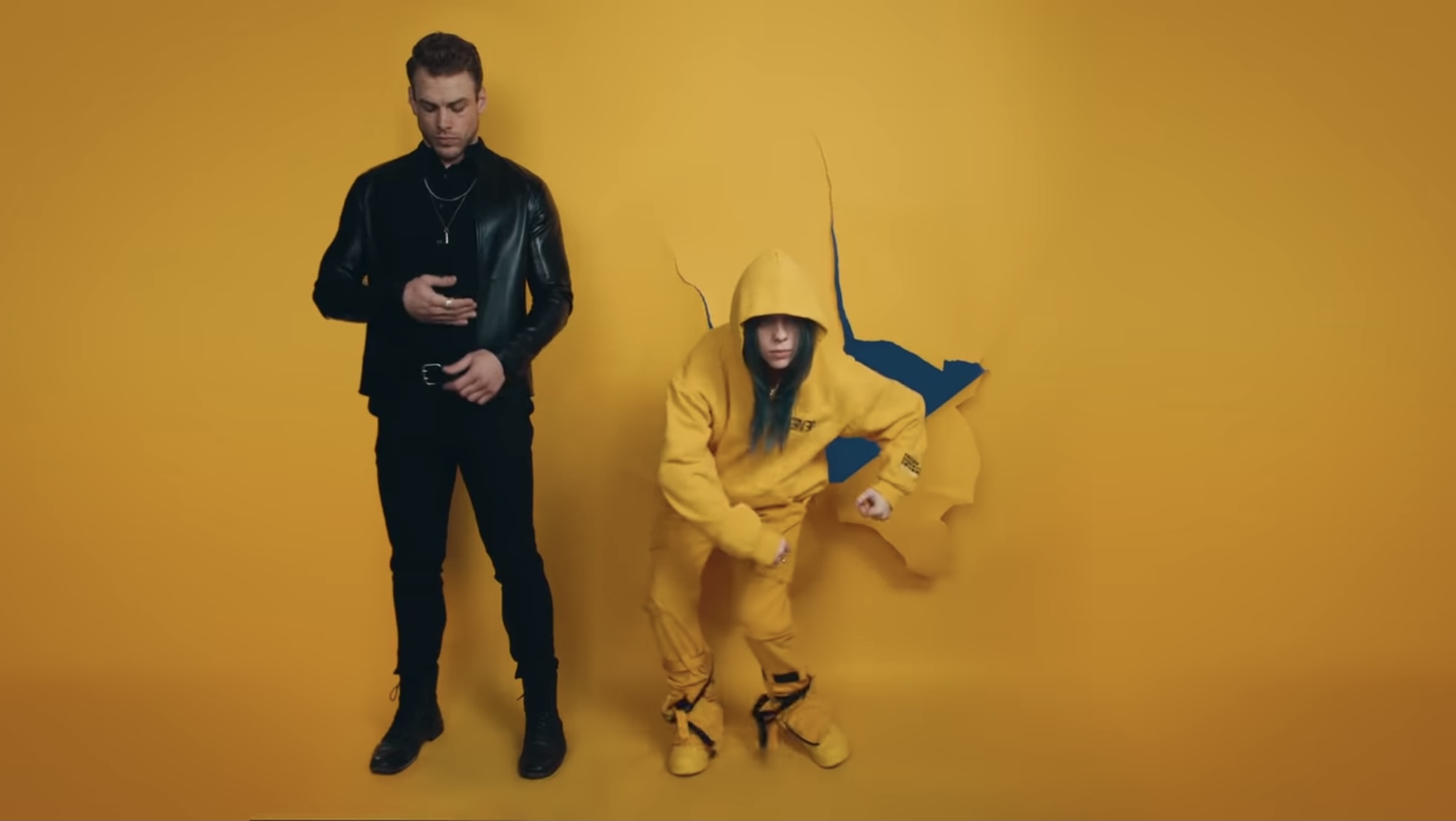
The official music video for bad guy extends this philosophy into the visual domain.
Constructed as a sequence of absurdist vignettes—milk spilling across her face, sudden nosebleeds, bodies reduced to props—the imagery resists linear interpretation. Instead, it mirrors the song’s psychological logic: playful, invasive, and faintly threatening.
Eilish’s sustained eye contact with the camera is central to the video’s effect. The gaze is neither seductive nor confrontational in a traditional sense. It is neutral, almost clinical, forcing the viewer into an unstable position between observer and participant.
The aesthetic rejects polish
No aspirational fantasy, no safe distance
In doing so, the video reframes pop visual language itself. Innocence and menace coexist without hierarchy, and vulnerability becomes a surface—controlled, presented, and never surrendered.
▶ Watch: Billie Eilish – bad guy (Official Music Video)
CULTURAL POSITIONING
Why bad guy Changed the Temperature of Pop
The cultural impact of bad guy lies not in its darkness, but in its restraint.
In an era where pop equated strength with loudness and empowerment with spectacle, Eilish introduced an alternative grammar: emotional minimalism, ironic detachment, and psychological proximity. After bad guy, pop did not become quieter—but it became more aware of silence.
This shift can be observed across the genre
- Confidence expressed through understatement
- Aggression replaced by indifference
- Power reframed as control over narrative distance
Eilish’s influence is not aesthetic imitation, but behavioral change. Artists began to leave space. Listeners learned to lean in.
THE ECHO OF AUTHENTICITY
Billie Eilish has not merely produced hit records; she has recalibrated pop’s emotional operating system.
bad guy endures because it articulates a modern truth: that authenticity is no longer about confession, but about precision. Knowing what to reveal, what to obscure, and when to withdraw has become a new form of authorship.
This is not rebellion through noise
It is disruption through control
In that sense, bad guy is less a song than a posture—one that invites listeners to confront their own contradictions, and to recognize the quiet gravity of the “bad guy” that lives, unspoken, beneath the surface

Billie Eilish - bad guy
Billie Eilish